


23 May 2025
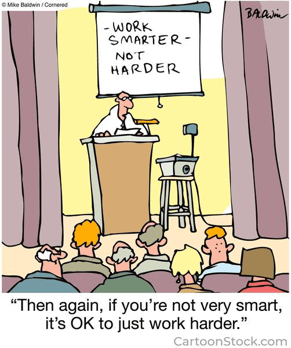
It is really counterintuitive (and very surprising) when you realise that you can actually often get more done by doing less, if you just work smarter, not harder.
It is about how much you accomplish, not about how hard you work; about how productive you are, not just about the hours you work.
There is also a difference between doing physical work and doing mental work; between doing ‘manual’ work and doing ‘thinking’ work. With manual work, you do the heavy lifting with your body, but with thinking work, you do the heavy lifting with your mind.
Therefore, the time that you spend doing something is often inconsequential to what you achieve in the long run. For example, if you are a manual worker, say in a factory, the accepted wisdom is that the more time you spend doing something, the more productive you are, but if you do a thinking task, the more thoughtfulness and mindfulness you bring to the task, the more productive that you usually are.
You always achieve much more within a shorter space of time if you are motivated, feel creative or are less tired, than if you just put in more hours feeling that this will eventually help you achieve what you want. In fact, it even means that you often work against yourself, so are less likely to achieve what you want, if you stay at a task for longer, if you are tired, feel less creative or are less motivated!
It is a fundamentally flawed conclusion that is commonly held to think that the more time that you spend on something, the more productive that you will be in the end. Whereas the opposite is actually true and sometimes it is actually counterproductive to focus on doing something for too long. You also need to try to work deliberately and intentionally as much as possible.
Try to also spend time doing things acting on autopilot wherever you can, rather than needlessly just thinking about doing things, instead of just doing them! Also, try to not just spend time doing things that do not really matter to you in the end, try to spend time wisely doing things that mean the most to you, even if they are things in your life that may not seem to be as ‘productive’ as others.
For example, even if it feels like time without purpose, such as relaxing, or being with your family, this time is actually as ‘productive’ as what you consider to be ‘work’. See it from the perspective of appreciation; you can’t appreciate ‘work’, unless you appreciate ‘relaxing’ and you can’t appreciate ‘relaxing’, unless you appreciate ‘work’. There is also a difference between ’time’ and ‘quality time’.
As I said, it is counterintuitive and defies logic to think that you may have actually been working against yourself, by spending more time doing something. What appears to be working harder though is often getting less done ultimately (or less done well), especially if you are tired, or feel under time pressure. Remember, your best ideas also usually appear if you are more relaxed and focused.
Finally, another thing that I have found, is that if you find a way to work more productively, you begin to carve out and save more time for yourself. And not only will you have more time, you will also not be so tired at the end of that day, so that you can then use the energy saved during the day to do all the other things that you wanted to do, but did not have the time or energy for before!
So, this week, remember that there is a difference between working hard and being productive and that the more things that you do or time you spend on them, the less productive you often are, so try to spend more of your time doing what you have to do, rather than just talking or thinking about what you have to do!
 🤔 Think Again