• CONSISTENCY IS THE KEY TO EVERYTHING…

    20th July 2026

    Today, I want to talk about how just showing up every day—day after day—will always be talent. Consistency is usually the key to everything in life. Consistency eliminates excuses and builds up real trust in yourself. 

    Over the years, I’ve slowly discovered that it’s the small, ordinary actions performed every day, or week, that create extraordinary outcomes. If you just show up daily or weekly, your momentum builds on its own. That sense of reliability matters infinitely more to you than having somebody else’s approval. 

    Real and lasting transformation isn’t achieved loudly and once in a flashy way, but rather quietly through persistent effort that compounds over time. When you know that you will honour your commitments to yourself, you unconsciously become someone that you can truly believe in. 

    When you skip showing up, your motivation evaporates, and your progress stops. However, if you’re consistent, it will gradually transform any humble effort into remarkable results in the long run. Consistency is the only bridge between dreaming of something and actually creating it.

    Here are some examples: 

    – if you regularly train three times a week, even for short periods, you’ll find that in around six months you’ll become much stronger, fitter, healthier, and genuinely come to enjoy it. That’s what consistency builds.

    – If you practice one skill for just 15 minutes daily, a year later, you will have devoted over 91 hours to mastering it. Your real expertise then emerges quietly.

    – If you save just £10 weekly, by the end of the year you will have saved £520 without feeling it. Wealth always grows when you show up faithfully like this.

    However, it’s also true that rigid routines can sometimes stifle growth and overlook what actually needs to change. Life isn’t predictable, and sometimes flexibility matters more than stubborn repetition. Blind consistency also risks missing crucial moments. 

    So today, show up for yourself consistently in small, quiet ways. Real change happens there, not in grand gestures, just through daily repetition. Remember, consistency is the key to everything!

  • WE SO OFTEN MISTAKE QUANTITY FOR QUALITY…

    13th July 2026

    Today I want to talk to you about why we so often mistake quantity for quality. It’s a tempting way to measure progress, but it’s a really bad bargain, and the cost tends to show up quietly, in work that never quite does what it was supposed to do.

    Have you ever noticed how we seem to have built a world that counts things? Hours worked, tasks finished, content published, etc? The unspoken assumption behind all of this is that whoever produces the most must be doing the best work. 

    There’s something genuinely satisfying about a long to-do list with things crossed off it. But crossing things off and doing them well are not the same achievement. That difference is usually invisible; right up until the moment it suddenly isn’t! What changes things isn’t doing less; it’s doing things with more care instead.

    The second look before you finish something and send it. The hour spent on the one thing that matters, rather than doing the 10 other things that just need doing. That’s not perfectionism; that’s the difference between doing work that holds up and doing work that quietly and quickly disappoints you and others.

    Here are some examples:

    – Someone who reads only 20 pages of a book with real focus will retain far more than one who skims 100 pages for the sake of it. Understanding and coverage are not the same thing.

    – A small business owner who delivers 10 genuinely good customer experiences will earn more referrals than one who processes 50 transactions without much thought. People remember the ones who paid attention.

    – A writer who produces one considered article a week will earn a more loyal readership than one who publishes daily content that never quite says anything. Readers return for substance, not frequency.

    Paradoxically, there is actually a fair argument for volume, as producing a lot is how you build a skill. Not everything here needs to be a masterpiece, and sometimes, done really is better than endlessly revised. The problem isn’t quantity itself; it’s when quantity becomes a habit that we stop questioning.

    So, today, remember that the goal was never to do more, it was always just to do better, and to do it in a way you can stand behind, so that you can consciously realise whenever possible that we so often mistake quantity for quality!

  • WE ARE SO SUGGESTIBLE…

    6th July 2026

    Today, I want to talk to you about why you’re more suggestible than you think, and how you can use this to your advantage if you do it right. That’s because your brain can’t actually tell the difference between someone else’s external voice and your own internal voice. 

    You know how someone criticises you once, and it sticks in your head for years? Or how a passing comment from someone at the beginning of the day can ruin your whole day? That’s suggestibility at work. All you’re doing here is believing something positive about yourself.  

    This means that whatever you say to yourself has exactly the same power as what someone else says. This isn’t just positive thinking; you’re already proving how suggestible you are every time you believe something negative about yourself. 

    The only question is then whether you keep letting random people programme your brain, or whether you’re going to start doing it deliberately yourself. If you’re going to be suggestible anyway, you might as well be suggestible to positive things you say, not negative and harmful things that others say. 

    Here are some examples:

    – Athletes use this technique all the time, without necessarily realising it. They say things like, “I’m stronger than I think”, or “I’ve got this” during a difficult stretch. This makes it feel easier for them because their minds accept it and their bodies respond accordingly.

    – Morning self-talk changes how your day goes. Tell yourself you can handle whatever comes up that day whilst having breakfast, and you’ll notice you approach problems differently that day; not because you’re magical, but because you’ve given your brain an instruction and it’s following it.

    – When panic or anxiety starts building up, telling yourself you’re calming down actually works. This is because your suggestible brain treats it as information rather than just wishful thinking. This thinking then starts shifting your nervous system to match what you’ve said.

    But you can’t just tell yourself you have abilities you haven’t developed or circumstances that don’t exist. Telling yourself you’re fluent in another language won’t help if you’ve never learned it. Self-suggestion only works with psychology and behaviour, not with objective reality, or skills that require actual practice.

    So, today, remember to use your own suggestibility on purpose. Deliberately say to yourself what you need to hear. Plant seeds in your mind that actually help you, and let your mind believe what it’s told. You are susceptible to things other people say, so start saying things to yourself, and you will believe them!

  • WHAT YOU LEARN FROM THE SHIP OF THESEUS…

    29th June 2026

    Today, I want to talk to you about how the Ship of Theseus thought experiment may be the most useful question you have never properly sat with. (Theseus was the hero in Greek mythology, famous for slaying the Minotaur). 

    The Ship of Theseus story is about a legendary ship preserved in Athens, whose planks were replaced one by one as they decayed. Eventually, nothing original remained, raising one of philosophy’s greatest unanswered questions: is it still the same ship?

    Most people pause at that. The pause is where the thinking starts. It’s not really about ships at all. It’s asking what holds anything together across time. Is it the material, the memory, the meaning, or simply the story we keep telling ourselves? That question has no clean answer, and that is the point.

    Here are some examples:

    – Your body replaces most of its cells roughly every seven to ten years, yet no one seriously disputes that you are still you. Identity is not a matter of matter alone.

    – A childhood home rebuilt after a fire, brick by brick, is still called their home by everyone who grew up there. Memory makes it real in a way that materials never can.

    – A long marriage holds two people who have each changed almost beyond recognition from the day they first met. What persists is not the people they were, but what they’ve quietly built together.

    Yet some things do become entirely different; insisting otherwise can blind you to what something is now. Someone once said, “A person never crosses the same river twice, because the river is never the same and the person is never the same”, yet we do return and feel we’re visiting the same place. 

    So, today, try to ask yourself, what is truly holding together the things and people you care about. Once you start looking, you find this question everywhere, so we can really learn from the Ship of Theseus thought experiment!

  • THE MORE YOU CHASE A FORGOTTEN THOUGHT, THE MORE IT RUNS AWAY FROM YOU…

    22nd June 2026

    Today, I want to talk to you about why the more you chase a forgotten thought, the more it runs away from you. I’ve noticed this happens to me constantly, and I’m guessing it happens to you, too.

    The moment you start chasing a thought that you have or want to remember, you’ve already lost and you have forgotten it. That tight, desperate grip we place on our memory sometimes only pushes it further away. The harder we squeeze, the more it escapes. It’s really frustrating and irritating, isn’t it?

    This is because your mind usually works better when you’re not interrogating it. It’s almost as though focusing conscious attention on a blank space makes it deeper, whereas you’ve got to stop looking to actually find it.

    There’s something almost spiritual about letting go. It’s not laziness, it’s just knowing when to step back and realising that the best way through sometimes isn’t always pushing straight ahead.

    Here are some examples:

    1. You’re mid-sentence talking to someone new and, even though they just told you it, their name just vanishes. You search and search your brain, feeling foolish. Then you’re buttering toast later, and suddenly there it is.
    2. That song you always loved plays constantly in your head, but try as you might, for the life of you, you just can’t remember its title. You hum it obsessively for days, getting nowhere. Then one morning, it just appears in your mind without warning.
    3. Your keys. You’ve lost them again! You ransack the house frantically, growing more panicked. You stop, breathe, and give up the search, then spot them on the windowsill immediately.

    Some will always argue that you need discipline and deliberate practice to strengthen memory. They’re not entirely wrong: focused study does help sometimes. But there’s a real difference between learning something new and recovering something already known.

    So, today, try to notice when you’re gripping too tightly at a thought. Loosen your hold, breathe, and let it breathe and remember that the more you chase a forgotten thought, the more it runs away from you!

14th March 2025

Similar to what I said last week about why I think that your mind and brain are different, this week I want to focus on the brain and explain why I also believe that your brain is not a computer.

Society seems to have developed this concept over time that the brain is really just a computer, a common misconception. But this is not really true when you think about it, because the brain is actually more specific and is also more general (another paradox). For example, whilst our brains are usually logical and very good at processing specific information, they often bring into play other more general ideas that we have learnt from other things.

The brain is best considered as a ‘thinking’ machine, which also has memory and storage capabilities, whereas computers should be thought of as being very good at storing and retrieving information, but which can also be programmed to do complex processes that seem to ‘think’ in some way. In fact, with the advent of ‘Artificial Intelligence’, some computers are now increasingly able to learn from themselves and then generate new original data to use, so appear to ’think’ more, especially if a task is more straightforward.

But that is not the same thing really. You have to be very deliberate and intentional in what you use your computer for (e.g. a computer is very reliable when retrieving information for you, or allowing you to develop a thought), but a computer is only a tool for you to use. Whereas your brain, whilst it also has to be deliberate and intentional to think, is more able to think for itself, but is not so good when it comes to remembering information.

What the brain finds easy is also what we feel is pleasant, so we have to be very careful to not let our brain rationalise something that we want to believe, just because it feels better to us. For example, it always amazes me how often I hear people trying to justify an argument logically, by rationalising it in a way that appears objective, but really is in a way that they just want to subjectively believe, but which objectively is very poor, bearing in mind the factual evidence.

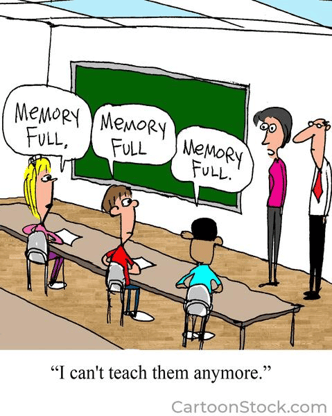
We also need to free up our brain from trying to remember information, so it is then more able to think clearly. The brain should be used for thinking and freed up of storing unnecessary information. It is for creating ideas, not for holding onto to them. This may mean that you need to first unwire and then rewire your brain. You also need to try to keep your thoughts outside of your brain, so that you can then see them more fully, pull them apart and then restructure or refine them (i.e. think about your thoughts!) Often our minds are so cluttered up with trivial information that we then find it hard to think properly.

In fact, there is a famous story of how a reporter once interviewed Albert Einstein for an article, then asked for his telephone number if he had further questions. “Certainly” said Einstein, but then had to go to retrieve it from the phonebook before writing it down for the reporter (he would look it up on the internet or on his mobile phone settings these days!).

“How can it be that a man considered to have one of the greatest minds like yours, cannot even remember his own phone number?”, the reporter asked. “I never fill up my brain with information that I can find elsewhere – why should I memorise something when I know where to find it?”, Einstein replied.

Finally, you also need to remember that the brain is different at different stages of your life. It is more malleable and able to learn as a child (which people call ‘neuroplasticity’), it is more prone to as risk-taking as a teenage brain (by the way, teenagers are also more collaborative and able to connect with peers than children or adults) and many adults can become fixed in their thinking and use the brain unconsciously to rationalise thoughts that they want to believe (egged on by the mind!)

So, this week, once again, please think about what I have said about and try to start using your brain more for thinking, rather than just being a storage facility for remembering information like you do on a computer, which is different.

Posted in